
What is Peppol?
In an increasingly digital business world, electronic processes play a vital role. Peppol is a pioneering initiative at the heart of this shift. As a major standard for the electronic exchange of business documents in Europe, Peppol has revolutionized the way companies interact and do business. This article will take a detailed look at Peppol, how it works, and the many benefits of the network.
First things first: What does Peppol mean?
Peppol stands for Pan-European Public ProcurementOnLineand was launched by the European Commission in 2008. The aim of Peppol as a non-profit organization is to harmonize B2B processes through uniform and simplified technology standards, especially at the international level.
However, Peppol is not a platform on which business documents such as invoices are exchanged. It is a network that connects many existing (state) platforms for a smooth exchange. One of the services of the network is the transmission of electronic invoices such as XRechnung.
Thanks to Peppol, all procurement and award procedures can be processed electronically and in a standardized and automated manner across national borders.
What is a Peppol Access Point?
The network is accessed via certified access points, known as Peppol Access Points. Technically, the network is based on the “4-corner model”. This means that both sender and recipient use the network via the Peppol Access Point. The sender’s electronic documents are then forwarded to the recipient’s access point using a unique Peppol ID and delivered to the recipient from there.
What is a Peppol ID?
The Peppol ID is the unique identifier of an organization that is connected to the network. You can use the Peppol ID to send and receive messages, invoices, and documents. To obtain a Peppol ID, network participants must contact one of the Peppol Access Point providers and register there.
Do you need Peppol access?
Good thing we’ve met here! We’re a certified Access Point Provider.
Schedule an introductory appointment today!
Efficient transfer of invoices with Peppol
In Germany, both authorities of the indirect federal administration and authorities of the direct federal administration are connected to the invoice receipt platforms ZRE and OZG-RE. The latter also have the option of using their own solutions for receiving e-invoices in addition to OZG-RE. However, this applies only as long as these also comply with European requirements and the German e-invoicing ordinance for the federal government.
Invoice issuers have four options for transmitting e-invoices to organizations with a connection to ZRE and OZG-RE:
Sending via the Peppol network
Sending
by e-mail
Web upload via
ZRE and OZG-RE
Manual data entry
Why you should use Peppol as an electronic transmission channel
Up to now, Peppol has been seen as the ideal solution for replacing electronic invoices and procurement in the B2G sector. But in the meantime, the Peppol network is no longer used exclusively for the exchange of invoices between companies and public authorities. In many countries, Peppol is also increasingly being used in the B2B sector. This is an international trend that, in view of the German efforts to introduce mandatory e-invoicing for B2B transactions and the subsequent electronic VAT reporting system, is also likely to find its way into Germany.The advantages of the Peppol network speak for themselves.
- In the Peppol network, you have access to the only transmission channel that enables fully automated machine-to-machine (M2M) communication and, at the same time, supports the easy mass export of e-invoices
- Save time and money with automatic processing
- Compliance with European e-invoicing standards and future global e-invoicing standards.
- Secure sending and receiving of electronic invoices
- Better cash flow
Ways to transmit an e-invoice with Peppol
Companies have various options for using Peppol as a transmission channel. They can use the ZRE and OZG-RE web services provided by the federal government, work with a Peppol services provider, or register themselves as a member of the OpenPeppol network (Open Peppol). The advantages and disadvantages of each option are briefly summarized here.Use of the online services of the federal government via Peppol
Advantage of the online service
- Free offer for sending e-invoices to ZRE and OZG-RE.
Disadvantage of the web service
- Can be used only for ZRE and OZG-RE.
- Only e-invoices in XRechnung format can be transmitted.
Use of an existing Peppol service provider
Advantage of the Peppol service provider
- The service provider guarantees the continuous availability of the network.
- In addition to e-invoices, it is also possible to exchange other documents and integrate various systems—not just ZRE and OZG-RE.
- Because you don’t need to set up your own access point, the complexity of the IT infrastructure remains unaffected.
- Cost control when concluding a contract with a Peppol service provider prevents unexpected expenses.
- No additional OpenPeppol membership is required.
Disadvantage of the Peppol service provider
- Use depends on the costs and technology of the Peppol service provider.
Membership of OpenPeppol (subject to a fee)[check]
Advantage of OpenPeppol
- Independence in the implementation of your own Peppol Access Point beyond the mere fulfillment of the mandatory requirements.
- Freedom of choice regarding the integration of the access point into the existing IT landscape.
- Opportunity to use the sale of access points as an additional source of income.
- Actively participate in shaping the technical and organizational future of Peppol as a member of OpenPeppol.
Disadvantage of OpenPeppol
- Full assumption of membership costs, installation of the Peppol access point, operation of the access point, and possible further costs
A look behind the scenes—How does the network work?
The European Peppol network forms an infrastructure for the Electronic exchange of business documents between two different parties such as companies and public administrations. Peppol enables a fast and efficient exchange of invoices, orders, and other documents. This leads to the standardization and simplified handling of business processes.Standardized document exchange helps
- promote interoperability,
- increase efficiency,
- and maximize security in the exchange of documents.
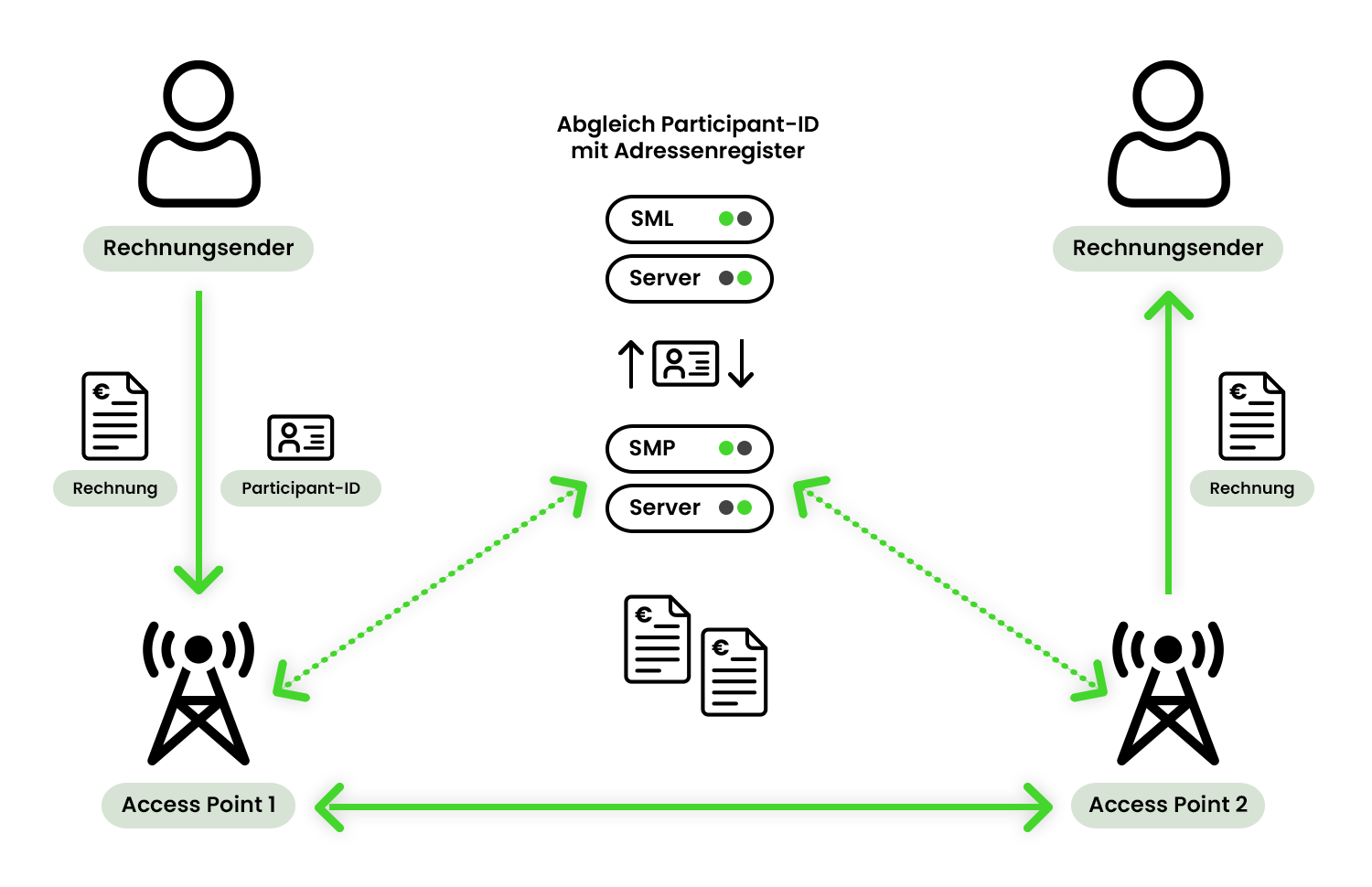
- Preparation for dispatch
The invoicing party loads the XRechnung invoices to be sent into its outgoing directory. - Upload and validation
The automated process copies the XRechnungen from the customer directory on the server into the send queue of our access point and validates the invoice. - Invoice provision
The recipient has access to their receiving directory and can retrieve the invoices from there.
Ready to transform your financial processes?
Talk to us about your challenges in purchasing, accounting, and invoice processing.
We’ll show you how cisbox can take your company to the next level.